The Fragility Crisis at the Atomic Scale
Imagine trying to conduct a symphony orchestra where every musician is blindfolded, hypersensitive to sound, and prone to forgetting their part if someone in the audience so much as coughs. This captures something essential about the challenge facing quantum computing hardware today, though the analogy barely scratches the surface of how delicate quantum states truly are. While classical computer bits exist in definitive states of 0 or 1, quantum bits exist in superposition, simultaneously embodying multiple possibilities until the moment they are observed or disturbed.
The scale problem here is mind-bending in its specificity. Quantum coherence, the phenomenon that allows qubits to maintain their superposed states, persists for microseconds to milliseconds in even the best current systems. To put this in perspective, if quantum coherence lasted as long as a human heartbeat, then the time it actually persists would be equivalent to about three seconds in the entire age of the universe. Recent breakthroughs from IBM and Google have pushed coherence times past 100 microseconds for some qubit types, but this progress is measured in the tiniest fractions of time you can imagine.
The breakthrough that has me most excited comes from researchers at QuTech in the Netherlands, who recently demonstrated silicon qubits with coherence times exceeding one second under specific conditions. This might sound modest, but in quantum computing terms, it’s roughly a thousand-fold improvement over typical performance just five years ago. The key is their use of isotopically purified silicon-28, which eliminates the magnetic noise from silicon-29 nuclei that typically destroys quantum states within microseconds.

Error Rates and the Mathematics of Impossibility
The error rate problem in quantum computing exists at a scale that challenges human intuition about precision. Current quantum computers operate with error rates between 0.1% and 1% per quantum gate operation. This sounds reasonable until you consider that useful quantum algorithms require thousands or millions of gate operations. The math becomes brutal quickly: if each operation has a 0.1% chance of error, then after 1,000 operations, the probability of at least one error approaches 63%. After 10,000 operations, you’re virtually guaranteed multiple errors.
What makes this scale problem particularly frustrating is that quantum error correction requires enormous overhead. Current theoretical frameworks suggest that each “logical qubit” capable of performing error-corrected computation may require between 1,000 and 10,000 physical qubits for error correction alone. IBM’s recent roadmap acknowledges this harsh reality, projecting systems with over one million physical qubits by 2033 to support just 100,000 logical qubits for meaningful computation.
The most promising recent development comes from researchers at Harvard and MIT, who demonstrated a 48-qubit system using neutral atoms trapped in optical tweezers. Their approach achieved error rates below 0.5% for two-qubit gates, which is the threshold where quantum error correction becomes theoretically viable. More importantly, they showed that their error rates actually improve as they add more qubits to certain configurations. This defies the typical assumption that larger systems inevitably become more error-prone.
Temperature Extremes and the Challenge of Absolute Zero
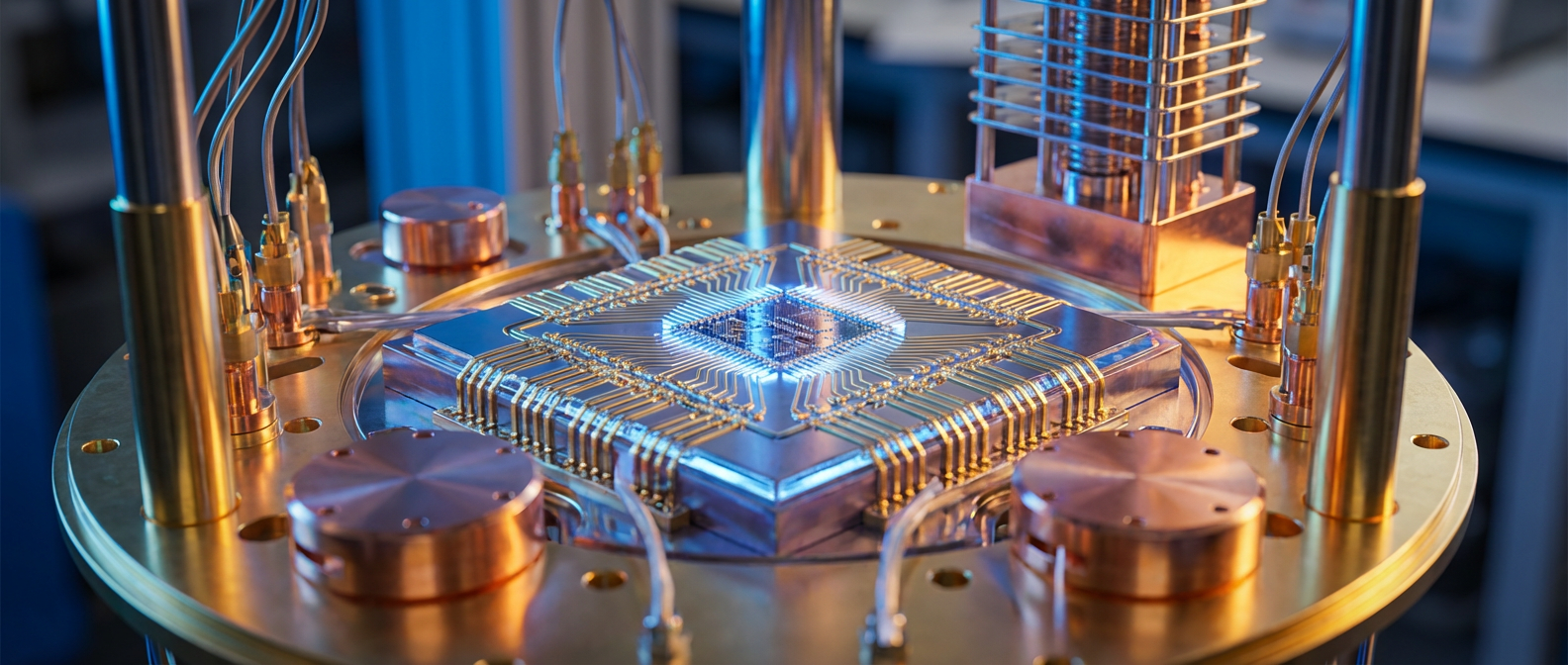
The temperature requirements for quantum computing hardware operate at a scale that redefines the meaning of cold. Most superconducting quantum computers require temperatures around 10 millikelvin, which is approximately 3,000 times colder than the cosmic microwave background radiation pervading all of space. To achieve these temperatures, quantum computers employ dilution refrigerators that can cost hundreds of thousands of dollars and consume kilowatts of electrical power to cool just a few cubic centimeters of space.
The scale comparison becomes even more striking when you consider energy levels. At these extreme temperatures, thermal energy becomes comparable to the energy differences between quantum states themselves. Room temperature thermal energy is about 25 millielectron volts, while the energy scales relevant to superconducting qubits are often just a few microelectron volts. This means that even tiny amounts of heat cause enormous disruptions to quantum coherence. It’s like trying to hear a whisper in the middle of a rock concert.
Recent breakthroughs in silicon quantum dots from Intel and SiQure have demonstrated qubit operation at temperatures up to 1 Kelvin. Still extraordinarily cold, but this is a 100-fold increase in operating temperature. This seemingly modest improvement could revolutionize quantum computing accessibility, as cooling to 1 Kelvin requires significantly less expensive and complex refrigeration systems. Even more exciting are reports from researchers at UNSW Sydney showing silicon qubits that maintain some quantum properties at temperatures up to 15 Kelvin, though full computational capability at these temperatures remains elusive.
Connectivity and the Network Effect at Quantum Scale
The connectivity problem in quantum computing reveals yet another dimension of the scale challenge. Unlike classical computers, where information can be copied and transmitted freely, quantum information cannot be duplicated because of the no-cloning theorem. This means that quantum computers must implement direct physical connections between qubits that need to interact, creating a three-dimensional engineering puzzle of extraordinary complexity.
Current quantum processors typically achieve connectivity where each qubit connects directly to between two and six neighbors. This sparse connectivity forces quantum algorithms to use many additional operations to move quantum information between distant qubits, dramatically increasing error accumulation. The scale of this limitation becomes clear when you realize that many quantum algorithms assume all-to-all connectivity, where every qubit can directly interact with every other qubit.
The most significant recent advance comes from IonQ’s trapped ion systems, which achieve near-perfect all-to-all connectivity by using laser pulses to create entangling gates between any pair of ions in their traps. Their latest 64-qubit system maintains this full connectivity while achieving gate fidelities above 99.8%. However, trapped ion systems face their own scale challenges. Laser control becomes exponentially more complex as ion chains grow longer, and the physical precision required for addressing individual ions approaches the fundamental limits of optical resolution.
The Path Forward Through Scale Thinking
What excites me most about current quantum computing hardware development is how researchers are learning to work with scale rather than against it. Instead of trying to eliminate quantum decoherence entirely, teams like those at Xanadu are building quantum computers that embrace noise and use it as a computational resource. Their photonic approach operates at room temperature precisely because photons naturally maintain quantum properties without requiring the extreme isolation needed by matter-based qubits.
The breakthrough that keeps me awake reading papers until 3am is the emerging understanding that quantum advantage might not require perfect qubits at all. Recent theoretical work suggests that quantum computers with error rates as high as 1% could still solve certain problems exponentially faster than classical computers, provided the problems are chosen carefully. This is a fundamental shift in thinking about the scale requirements for useful quantum computation.
The quantum computing hardware world continues evolving at a pace that makes every month bring genuinely surprising developments. If you find yourself as fascinated by these scale challenges as I am, I’d love to hear about which quantum hardware breakthrough has captured your imagination. Or whether you have insights about how we might solve the seemingly impossible engineering problems that define this field.